
All About Supervision: How We Keep Your Child Safe, Engaged, and Thriving
For parents, hearing that your child had a mishap at care can bring up a natural wave of worry. Whether it is a scraped knee, a sudden tussle over a toy, or a bump on the head, it is completely natural to wonder: “How did this happen, and what were the Educators doing?”
At Sustainable Play, we completely understand that question. Your child’s safety is your highest priority, and it is ours too. To help build your confidence in our care, we want to take you behind the scenes.
Supervision in a high-quality early childhood setting is vastly different from just “watching” children play. It is a highly professional skill. The Australian Children’s Education and Care Quality Authority (ACECQA) advises centres to consider how their supervision is:
ACTIVE: intentional, relational and engaged
DYNAMIC: responsive and flexible, and
EFFECTIVE: reflective and evaluative.
Read on to see how we envelop these characteristics of supervision into our practice.
Built for Safety: Our Open-Plan Environment
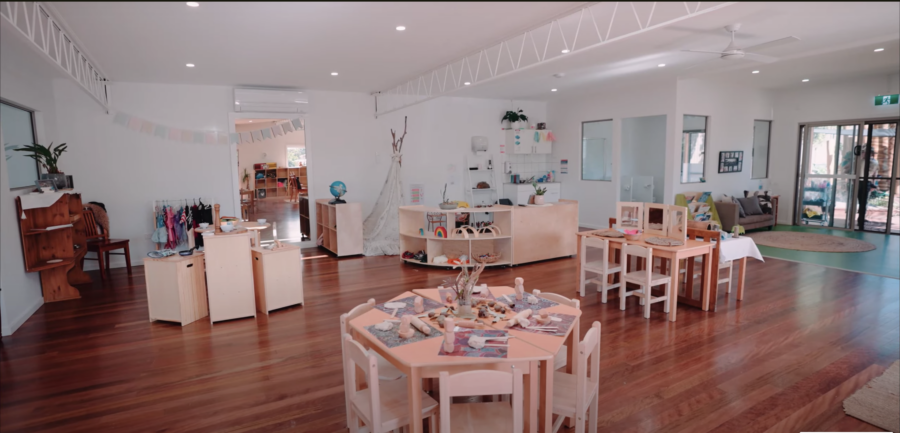
Our commitment to your child’s safety starts with the physical layout of our centre. We intentionally designed our spaces with purpose-built, open-plan rooms.
By keeping furniture and shelving low, we remove hidden blind spots. This transparency allows our Educators to maintain continuous, unobstructed sightlines across the entire room, ensuring your child is always visible even when they are enjoying a quiet moment in our calm co-regulation spaces.
What Active Supervision Really Looks Like
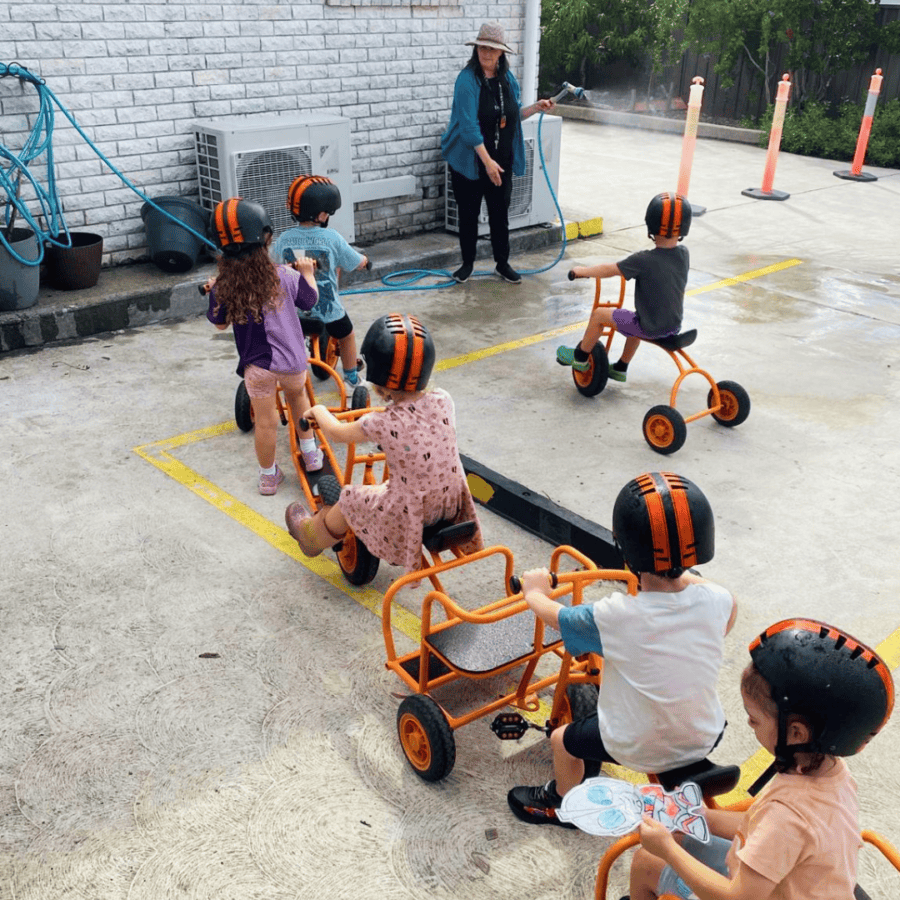
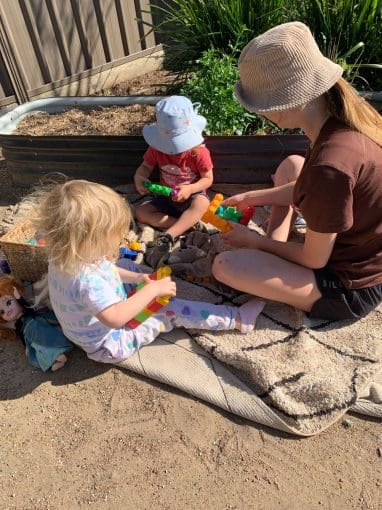
When you visit our spaces, you won’t see Educators standing back passively. Effective supervision is intentional, dynamic, and constantly moving.
At any given second, our Educators are managing a complex, multi-layered environment utilising the following strategies:
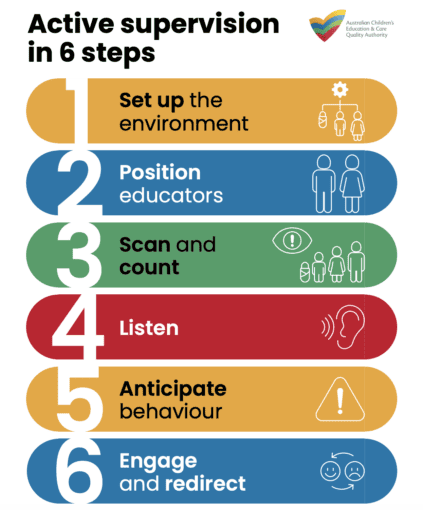
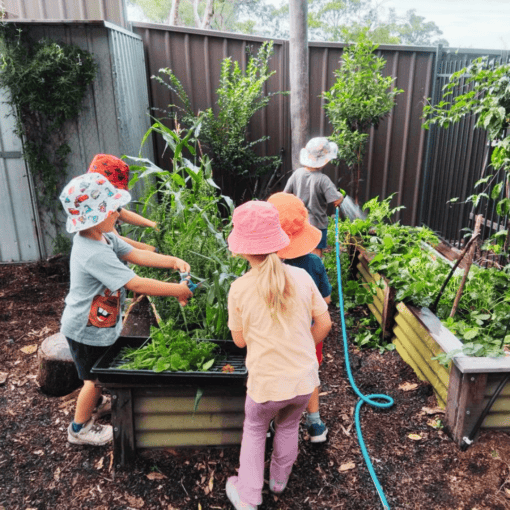
- Strategic positioning: Educators share supervision of our indoor and outdoor environments. As children move, Educators adjust their positions in tandem, taking consideration of their body positioning, and ensuring no area is ever left unsupervised.
- Dedicated areas: We use fencing to zone off areas that are higher risk for supervision and to allow for quality, small group experiences. Over time, our environments have required these boundaries in order to keep children safe and reduce Educators’ blind spots.
- Radio communication: Each zone is equipped with walkie talkies so Educators can relay the movement of children from one area to another, or request assistance and move Educators as needed to maintain ratios.
- Scanning: Continuously mapping the room and positioning themselves to maintain clear sight lines across active play areas.
- Head counts: Our Educators are regularly taking head counts throughout the day, during transitions, and at excursions.
- Listening: Tuning into shifts in children’s voices, laughter, or quietness to anticipate needs before they arise.
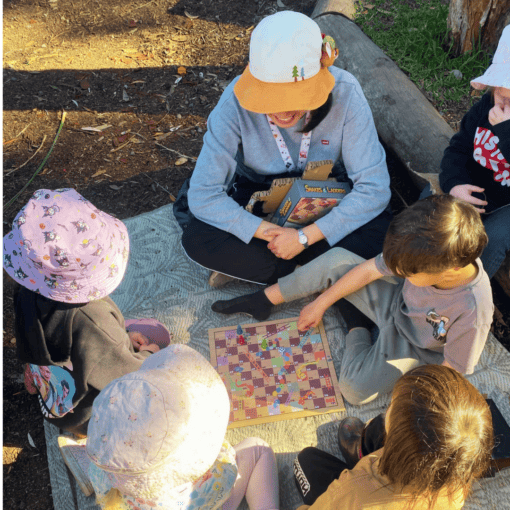
- Engaging with children: One way to supervise a group of children is to plan a game or experience for them. An Educator’s active engagement with a group, allows them to supervise and connect simultaneously.
- Anticipate + Redirect children: Educators will calmly step in as needed to shift a child’s attention away from unsafe behaviour and guide them toward a safe, positive choice before a situation escalates
When an Educator needs to comfort a child or change a nappy, the team actively adjusts, communicates over the radios and stays tuned into the needs of the children under their supervision.
See ACECQA’s guide below on 6 steps for active supervision:
Why Early Childhood Development is Fast-Paced
- A child running might trip over their own feet.
- Two children might reach for the exact same block at the exact same fraction of a second.
- A boundary might be crossed during an intense game.
Balancing Absolute Safety with Necessary Growth
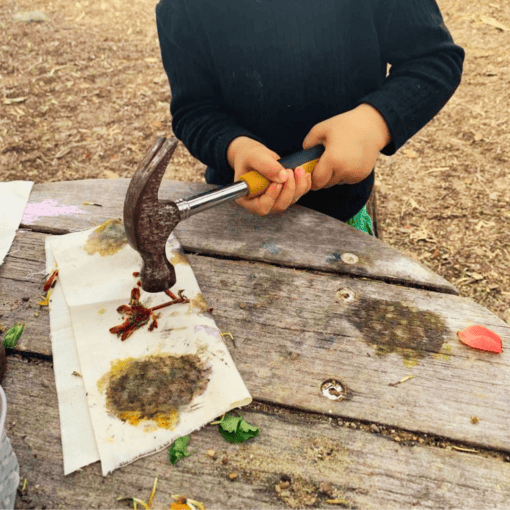
Quality supervision does not mean “hovering.” If an adult over-manages every single interaction and movement, children miss out on vital life skills. We must give children the opportunity for necessary growth, which means we cannot bubble wrap them for absolute safety, but strive to strike the right balance.
We create safe environments that still allow children the freedom to:
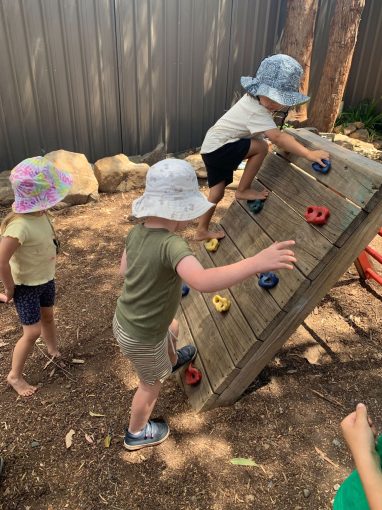
- Build Resilience: Learning to safely navigate age-appropriate physical challenges.
- Develop Independence: Making decisions and testing their own capabilities.
- Negotiate Friendships: Figuring out how to share, wait for turns, and resolve minor disagreements.
- Assess risk: Risky play is an important part of our philosophy – research shows that children who practice assessing risks through supervised and scaffolded risky play are better at avoiding danger and injury.
Our role is not to eliminate every obstacle from childhood. It is to create a secure perimeter where children can safely test their limits, knowing trusted adults are right there to guide them.
While Prevention is #1, Quality Response is #2
While preventative supervision is our first line of defense, the true measure of an exceptional childcare centre is how Educators respond when an incident does occur.
Whenever a child is hurt or upset, we respond with:
- Comfort & Care: Administering first aid and ensuring the child feels safe, heard, and supported.
- Guidance: Helping both children involved process their emotions and understand what happened.
- Investigation: Reviewing the event to understand the root cause.
- Reflection: Asking ourselves, “Do we need to alter the room layout? Should we adjust our Educator positioning?”
- Communication: Sharing the details openly and honestly with you, the family.
A Shared Commitment to Your Child
Our Educators care deeply about your family. When an incident occurs, we don’t just fill out a form—we reflect on it, discuss it as a team, and use it to continuously refine our practices.
We view our relationship with parents as a true partnership built on trust, transparency, and shared goals. We cannot stop every stumble, but we can promise a protective, responsive, and deeply compassionate environment where your child can safely grow into their best self.